Showing posts with label review. Show all posts

Thursday, October 12, 2017

All Yume Wo Katare Coverage

October 11, 2012 11:27pm
Trial run for friends & family


Yume Wo Katare turns five today!! For their fifth anniversary they opened an udon shop, Yume Ga Arukara. おめでとう! Omedetō!

I thought I'd collect all my coverage in one place for Yume fans. 😊

Wednesday, February 10, 2016

Exhibit: Twisted Again: The New Kumihimo @ Wedeman Gallery in The Yamawaki Art Center

Obi braided by Makiko Tada, Japan
Original obi tie method by Matsuko Levin, US
Kimono on loan from the collection of Matsuko Levin


After attending the MFA panel on Kimono Wednesdays on Sunday I dashed off to Newton to the opening reception of Twisted Again: The New Kumihimo, an exhibit of kumihimo art. Kumihimo is a Japanese textile art that traditionally involves the braiding of silk strands to make a cord. The exhibit showcases the work of six female artists from Japan, the US, the UK, and Australia who work with a variety of materials from the more traditional silk to modern materials such as monofilament. The pieces were really diverse and beautiful. It's a little out of the way for those who live in the city, but well worth the trip.

Twisted Again: The New Kumihimo

Follow the tracks of the ancient caravans and nomadic peoples throughout the world and you will find braids – fiber interlaced on the bias to make strong bands, belts, and cords needed to make everyday life possible. Using natural fibers of different shades, wonderful patterns emerged.  When traders came to a natural stopping point, like the Island of Japan, various stands to make the braids were invented and perfected making possible more and more complex braids using dozens of bobbins of many colors in multiple layers. The Japanese word for making these complex braids is “Kumihimo”.
While there is no census, and there are many braiders and ways to braid, maybe only 100 or so people in the world work at the advanced levels of Kumihimo.  In the making, there is a great sense of connection with the past and pleasure in rediscovering and perfecting the traditional patterns and working with the silk made in Japan only for work in Kumihimo.   But for some, Kumihimo is also a path for innovation and personal expression.  It becomes not just a technique but an art medium.  We celebrate this group in this show.
Our show brings together the work of six artists using the Kumihimo braiding techniques, all of whom are innovators with a unique voice. This first in the US show combines work from four continents: Australia, Japan, the UK, and the US.  When you come to the show, you will have a unique opportunity to listen in on the conversation between individuals and cultures as seen through these works.  Some follow an engineering approach – inventing new braid structures to create never-before-seen patterns and effects. Others follow a more evolutionary approach, experimenting with the process to see what will emerge as a piece grows.  While the traditional silk is still much in evidence, all of the artists experiment with different materials and fibers including paper, monofilament, and wire. Some want some functionality in their work and so have gone in the direction of fashion applications, true wearable art.  Others have left functionality and focus on art expression. But no matter the direction of exploration, these works all exude the joy and delight of discovery.

Date & Time
Open through Saturday, February 20, 2016
(Note: Some sites and materials mistakenly show the exhibit as being open through the 22nd.)
Informal conversation with curator and artist, Lyn Christiansen, on Friday, February 12, 2016, 4:00 - 6:00pm.
Please see the exhibit website for hours.

Location
Wedeman Gallery at the Yamawaki Art and Cultural Center at Lasell College
47 Myrtle Ave., Newton, MA 02466

Admission
Free

Flowers, Flowers, Flowers
Hiroko Ojima, Japan

Pieces by Jacqui Carey, UK

Wheel of Fortune
Lyn Christiansen, US

A nice feature of the exhibit is that there's a "Touch Table" with examples of most of the work in the exhibit. As a fiber artist I always want to touch textile arts, but it's a rarity to be able to do so. This was a great idea.


This was a completely unexpected find. Apparently Lasell College has owned this Japanese temple bell from Myokoku (outside Kyoto) since the 1800s when it was bought by Milton S. Vail, a friend of Lasell's principal, Dr. Charles C. Bragdon. This is not the only Japanese temple bell in the area. There is another Edo era Japanese temple bell in the Back Bay Fens. The Emerald Necklace Conservancy offers docent-led tours to see it.

Japanese Temple Bell
early 1800s, Edo period

Additional photos here.

Exhibit: Made in the Americas @ MFA

I had intended to write something much longer about this exhibit but I've run out of time. This is the last week of the MFA's Made in the Americas: The New World Discovers Asia. Made in the Americas showcases the work of artists from North and South America, including indigenous artists, who were influenced by goods coming in from Asia. Some of the objects in this exhibit come from the MFA's own collection and some were loaned from The Hispanic Society of America in New York and the Metropolitan Museum of Art.

In some cases they copied motifs (shown with a Peruvian tapestry that included Chinese mythological creatures and was clearly copied from imported Chinese textiles) and in others, came up with new techniques to replicate the look of Asian art (as with japanning). These days many of these artists would likely be accused cultural appropriation. It was incredible to see the way Asian art had inspired them to create art that was similar but uniquely their own. If you have time to see it before it closes on Monday, February 15th, I highly recommend it.

Made in the Americas: The New World Discovers Asia

Within decades of the “discovery” of America by Spain in 1492, goods from Asia traversed the globe via Spanish and Portuguese traders. The Americas became a major destination for Asian objects and Mexico became an international hub of commerce. The impact of the importation of these goods was immediate and widespread, both among the European colonizers and the indigenous populations, who readily adapted their own artistic traditions to the new fashion for Asian imports.

“Made in the Americas” is the first large-scale, Pan-American exhibition to examine the profound influence of Asia on the arts of the colonial Americas. Featuring nearly 100 of the most extraordinary objects produced in the colonies, this exhibition explores the rich, complex story of how craftsmen throughout the hemisphere adapted Asian styles in a range of materials—from furniture to silverwork, textiles, ceramics, and painting. Exquisite objects from Mexico City, Lima, Quito, Quebec City, Boston, New York, and Philadelphia, dating from the 17th to the early 19th centuries, include blue-and-white talavera ceramics copied from imported Chinese porcelains, elaborately decorated furniture inspired by imported Japanese lacquer, and luxuriously woven textiles made to replicate fine silks and cottons imported from China and India.

The timing of the exhibition marks the 450th anniversary of the beginning of the Manila-Acapulco Galleon trade between the Philippines and Mexico, which was inaugurated in 1565 and ended in 1815, two and a half centuries later.

Date & Time
Through Monday, February 15, 2016
See MFA's website for hours.

Related talk: The Role of Religious Orders and the Introduction of Asian Arts to the Americas, Saturday, February 13, 2:00 - 3:00pm

Location
Museum of Fine Arts, Lois B. and Michael K. Torf Gallery (Gallery 184)
465 Huntington Ave., Boston, MA 02115

The Southern Barbarians Come to Trader
Kanō Naizen

A Peruvian Cover is on display alongside a Chinese embroidered tapestry (on loan from the Metropolitan Museum of Art) that was made for export. Such tapestries have never been found in South America but were known to have been exported to Europe and the Americas. The MFA notes in the label that the Peruvian artisans "closely cop[ied] their format, style, and iconography." You can see how similar the motifs are, in particular, the mythical xieshi. The Chinese embroidery is believed to be from the Guangzhou region and was probably exported to Japan in the 17th century. It has been heavily re-embroidered, most likely in Japan in the 19th century. (Additional information provided by Pamela Parmal, Curator of Textiles and Fashion Arts.)

Left: Peruvian Cover, late 17th to early 18th century
Right: Panel with flowers, birds, and animals, 17th century

Description of Chinese motifs that were copied in Peruvian Cover

High chest of drawers, about 1730-40
Japanned butternut, maple, white pine

They also showed that the influence was not one-way, with this interesting panel by an unknown Japanese artist.

European King and Members of His Court
泰西王候図屏風 (Taisei ôkô zu byôbu)
Momoyama period 1601-14

Updates:
  • 2/11/15: Added information about Panel with flowers, birds, and animals.

Wednesday, October 14, 2015

Happy Anniversary to The Genki Spark!


This is a long overdue post about The Genki Spark! (Sorry Karen!)

The Genki Spark was founded in 2010, by sansei Chinese/Japanese American Karen Young, who was also a founding member of Odaiko New England. They are the first and only all-Asian all-female taiko performance troupe in the United States. This year they're celebrating their 5th anniversary! On their website they describe themselves as "a multi-generational, pan-Asian women's arts and advocacy organization that uses Japanese taiko drumming, personal stories, and creativity to build community, develop leadership, and advocate respect for all." They are a "fiscally sponsored project of AARW".

Karen Young and Kay Fukumoto at Great Grandfather's Drum screening, June 28, 2013

Initially they performed mainly in New England, but they have become such a big deal that they were invited to the UK Taiko Festival in Exeter earlier this year and have also performed around the US at conferences, schools, and taiko events. They perform at and host a lot of community events in the Boston area and are active in educating people about the WWII incarceration of Japanese and Japanese Americans. They have gone on the Tule Lake Pilgrimage twice and hosted events to talk about what it was like for them to attend as Japanese Americans, Japanese, and other women in the Asian diaspora. For the past four years they have been co-hosting the Brookline Cherry Blossom Festival, a mid-sized family-friendly matsuri, with Brookline High School and they also participate in Hana Japan's annual Natsu Matsuri.

Obon dance at 2015 Brookline Cherry Blossom Festival

In addition to performing, The Genki Spark offers public taiko workshops for beginners. I took one of these workshops a couple of years ago. Actual taiko drums are very expensive, so they had about half chu daiko (pictured below) and half gomi daiko (drums made from trash cans which you can make at home). Class was taught by Karen, who has been playing for over 20 years. A previous version of Karen's bio referred to her as a "taiko cheerleader" which you can definitely see when she talks about taiko. Karen was a patient and enthusiastic sensei and coach. After introductions and a brief warm up, which had me flashing back to my days in nihongo gakko (Japanese Saturday school) when we had to do calisthenics, Karen led us through the basics of how to hit the chu daiko and gomi daiko with our bachi while shouting (kiai). With 11 students beating on drums in a small dance studio it got very loud, so earplugs were provided.


At the end of class we all got to choose from The Genki Spark's epic pin collection! Would highly recommend the workshop to everyone! It makes a great outing with friends. All genders and ages welcome, no musical experience necessary, and it's quite a workout. I was sore for days! (After class, my friends and I had dinner around the corner at Shiki. Perfect way to cap off an evening of taiko!)

Info table at Great Grandfather's Drum screening

Like many other women of Asian descent who perform taiko, the women of The Genki Spark have come to taiko because it's pretty much the opposite of what you're taught about how you should behave as an Asian woman. It's loud – both the drumming and the shouting, involves strength, and is sweaty work. It's the opposite of proper, but it's gorgeous. In Japan taiko has historically been the exclusive domain of men although that has been changing over the past 30 years. In the United States, taiko groups are often mixed gender and more focused on community and were one of the ways Japanese Americans reclaimed Japanese culture after WWII.

2014 Brookline Sakura Matsuri Festival

The Genki Spark is currently in their annual recruitment period for new members. Their second four week trial class starts this Sunday, October 18th and the third trial class starts Sunday, November 15th. First class is free! After that there's a one to three month intensive training program and after that you can apply for membership. If you think you'd be interested in joining, you should sign up! Group membership is open to anyone who self-identifies as female and Asian.
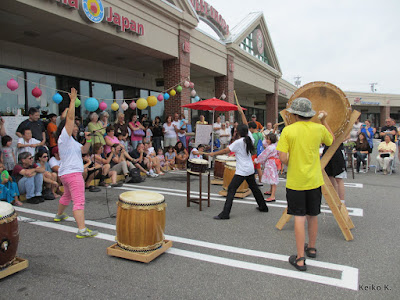
Audience tries taiko at Hana Japan's Natsu Matsuri, August 18, 2013

I don't get to as many Genk Spark events as I'd like to but I've enjoyed every one that I've attended. I love that they are a multigenerational group. Their current age range is 17 to 60. I feel like in modern society we spend far too much time primarily with people our own age. They do an incredible job of promoting community everywhere they go. Check out their YouTube channel to see video profiles of some of their members.


Their 5th anniversary celebration and fundraiser is this Saturday at EMW. Doors open at 5pm with light refreshments. At 6pm they will be screening Tufts alumna Misako Ono's documentary about the group, followed by a discussion and cake! Hope some of you can make it!

Members of The Genki Spark at Hana Japan's Natsu Matsuri, August 18, 2013

See also:

*****
This post has been crossposted at Discover Nikkei, a multi-lingual Nikkei online community. 

From their website: "Discover Nikkei is a community website about Nikkei identity, history and experiences. The goal of this project is to provide an inviting space for the community to share, explore, and connect with each other through diverse Nikkei experiences, culture, and history." Discover Nikkei is coordinated by the Japanese American National Museum and supported by The Nippon Foundation.

Tuesday, September 8, 2015

Hana Japan: Family-run restaurant in Newburyport


Tucked in the Port Plaza Shopping Center at 45 Storey Ave., Newburyport, MA, you might not expect much from a Japanese restaurant in a strip mall but unlike the majority of Japanese restaurants in the Greater Boston area, Hana Japan is family-owned and operated by the Takahashi family – Miyano-san and her children Kosuke and Shino. It has the feel of a small mom and pop restaurant in Japan.

Sushi bar @ Hana Japan

Tewassa had a lunch outing to Hana Japan in Newburyport on Saturday. It was my first time there for a regular meal. We have tabled at their annual Natsu Matsuri a few times. Hana Japan has also been one of the food vendors at the the Brookline Cherry Blossom Festival for the past two years and Miyano-san and her dance troupe, Takahashi Minyo Kai, have performed at the festival.

When you first enter there's a little gift shop to the right with an eclectic mix of new and vintage Japanese goods including toys and snacks, origami, handmade cards by a local artist, dishes, and other odds and ends (I saw a pair of handmade zori!). Behind that there is a sushi bar (seats 5 or 6 – forgot to count), and on the left side are tables (forgot to count chairs but I think it seats around 35).

The most interesting decoration is this incredibly ornate uchikake. It was modeled at last month's Natsu Matsuri in the Boston Kimono Club Kimono Show. I took some close-ups beginning here. You can see there's a big difference in the craftsmanship between something made by professional kimono artisans and the replica theatrical uchikake made by Takarazuka Stage Co. for the MFA's Looking East touring exhibit (close-ups begin here).

Boston Kimono Club Kimono Show @ Hana Japan Natsu Matsuri 8/16/15

Almost everyone ordered bento (there are many different options) but I decided to go with the Aspara Maki lunch special since I'd never seen anything like it at other local Japanese restaurants. It is Hana Japan's take on aspara maki (アスパラ巻き), a beef or bacon wrapped asparagus dish served at yakitori restaurants. Comes with rice, miso soup (which I skipped due to being allergic), a small salad, and some fruit for dessert. The beef was a little on the chewy side for me (I have TMJ) and some might find the teriyaki sauce too sweet but overall it was tasty and a nice change. I also had some house-made gyoza. Ahh, childhood memories. Most local Japanese restaurants serve commercially-made frozen gyoza because making fresh gyoza is too time-consuming. (Update 11/22/15: Oops, found out today from one of the Takahashis that the gyoza they serve are not house made. They did make their gyoza in-house briefly but switched to commercially made.) One of my friends got Katsu, which looked good. (I didn't want to delay everyone's lunch so I didn't take any other food photos, but you can see more on their Facebook page and on Yelp.)

A couple of things to note for those with dietary issues: one friend commented that the miso soup was on the salty side and they are quite generous with sauces (by Japanese standards). Ask for your sauce on the side if you need to watch your salt/sugar intake.

Aspara Maki lunch special - $13.50

During the Kimono Wednesdays protests I heard from friends and family that there are some places in the US (Hawaii and West Coast) that do kimono dress up and photography like they do in Japan but I wasn't aware of anywhere in our area that offered this. It turns out that Hana Japan offers a Kimono Experience – $50 just to dress up (you may take your own photos) or $150+ for professional photography with Shino.

If Hana Japan weren't so far away I would go more often, but it's a bit of a hike for me. If you're in the North Shore or southern New Hampshire it's worth stopping by but check their hours first. They are closed on Sundays, close between lunch and dinner, and are only open for lunch Tuesday through Saturday. Holiday closures are posted to their Facebook page. We were there ~1-3pm and were more than half the customers during that time. I'm not sure if they were less busy due to the holiday weekend or if Saturday lunch is usually quiet.

The restaurant is family-friendly. They have some toys and crayons and the gift shop is fun for kids to explore, but they should be supervised due to the breakables and delicate objects.

Additional photos here.

Saturday, June 28, 2014

Film: Documented


So, I’m a little embarrassed to admit that I’ve paid virtually no attention to the immigration debate because I didn't think it had anything to do with me. My mom’s parents emigrated from Okinawa to Hawaii before it was even a state, but they did so legally. My dad also came to the US legally. On the Hawaii side of my family, I’m the only one of my generation who wasn’t born in the US, but because my mom was a US citizen and she registered my birth abroad, I am technically not an immigrant - I automatically got US citizenship. I didn't have to do anything for it. I did not realize how privileged that makes me.

After going to see Vincent Who? last month it seems the New England ADL automatically put me on their mailing list and a few weeks ago I got an invitation to a screening of Documented: a film by an illegal immigrant undocumented American. The trailer was captivating and Jose Antonio Vargas, the subject, writer, director, and producer of the film was going to be on hand for a Q&A so I went. I didn’t realize until the opening credits were rolling that Japanese American producer Kevin Iwashina (whose films I keep finding myself watching) co-executive produced the film!

Since Jose is a journalist I had expected a newsy documentary with lots of facts and figures and arguments with his personal story as a backdrop, but instead the film was a deeply personal narrative about how he came to be in the United States illegally and what happened after he found out. When he was 12, his grandfather (who had immigrated to the US legally) arranged for a smuggler to bring him to the US so he could live with his grandparents and have a better life than he could back in the Philippines. When he was taken to the airport, he was told the man was his uncle. It would be another four years before he found out that his documents were fake. After that he found it easier to come out of the gay closet than the undocumented closet and he spent years mostly hiding his immigration status (sharing it with only a few trusted mentors) before eventually coming out in the New York Times Magazine at age 30. At the time he'd been living in the US for 18 years - more than half his life. The Philippines was no longer home. He considered himself an American but he had no papers to back that up. His only paths to citizenship would be to go back to the Philippines, wait ten years, then apply to come back to the US or marry an American, which was complicated by us not having equal marriage in all states and the federal government not recognizing those marriages at the time. Since DOMA was overturned, the federal government has begun to allow people in same gender relationships to sponsor their spouses. Jose told us after the film that he has 16 lawyers and they think that marrying a man might be the solution, but they're not sure.
 
Jose is in a rare position. So far, ICE hasn't tried to deport him. He acknowledged afterwards that he knows he's the most privileged undocumented person in America. He's educated. He has a lot of support. He has a high profile because he worked as a journalist for many years. He has a lot of connections (not too many undocumented Americans can say they know Marc Zuckerberg). He even won a Pulitzer Prize. He was quick to emphasize that his story is only one of millions, but it was a story he felt he should tell because he's in a position to do so. Much of the film focuses on the difficulties he's had with his mom who was left behind in the Philippines. He hasn't seen her in person since he left and their relationship became strained over the years after Jose learned about her part in sending him here illegally and he was upset that she didn't follow him as promised. He sent a crew to film his mom in the Philippines so you get to see both her perspective and Jose's about what it's been like for them to be separated all these years and the ups and down their relationship has gone through. Jose hoped that people would be able to connect with his story on a human level. Everyone understands family.

I was struck by Jose's path to activism. In the film he talked about watching YouTube videos of young undocumented people who were speaking up as being "undocumented and unafraid". He began to feel guilty. Here were people younger than he risking deportation to try and change things so that they and others in the same boat could get citizenship and stay in the country they call home. It reminded me a lot of why I came out. I watched a lot of It Gets Better videos on YouTube mainly from people younger than I, and I felt guilty. If they could be brave, why couldn't I? During the Q&A Jose said he saw parallels between the battles for LGBT rights and immigrant rights. He thinks immigration reform will go like LGBT rights - state by state. Equal marriage has only been possible because the culture shifted before the politics did. He believes that stories and art have the power to liberate people which is why he made the film. For the past few years he's be traveling the country showing the film and hoping to change the dialogue about illegal immigration, proving it's never too late to become involved.

I wish the Q&A had been longer and better organized. We didn't get to hear much from Jose because questions weren't screened and most of the people who "asked questions" seemed to be more interested in hearing themselves talk than in hearing Jose speak. The last question was really excellent though. A young American man told Jose that his best friend was undocumented. His friend is smart and interested in politics but he's feeling hopeless because right now he doesn't see a way out of his situation or a way to achieve his goals. The young man wanted to know how he could encourage his friend. Jose commended him for being a great ally and said to pass on to his friend, " I just hope you don't say no to yourself."

I would imagine that undocumented Japanese numbers are pretty low these days given overall Japanese immigration numbers which are down (unfortunately I couldn’t find any stats), but certainly not all the issei who came here back in the day came here legally. But that was a long time ago. Why should we care? I found a great piece on Racialicious - Japanese Americans and Immigration: Where We Fit that explains why it's still relevant to Japanese Americans. It was written by yonsei Kristin Fukushima a few years ago when she was Public Policy Coordinator for the Japanese American Citizens League Pacific Southwest District.

Until now Documented has only been shown at private screenings, but if you have cable, you can watch it tomorrow on CNN. They snagged the US distribution rights and the film will have it's television premiere tomorrow, Sunday, June 29th at 9pm ET and will air again at 11pm ET. If you miss it tomorrow CNN will air it again next Saturday, July 5th at 9 and 11pm ET. Details here.

If you're not able to watch the film on CNN, they're currently taking pre-orders for streaming or download on the film's website.
 *****
This post has been crossposted at Discover Nikkei, a multi-lingual Nikkei online community. 

From their website: "Discover Nikkei is a community website about Nikkei identity, history and experiences. The goal of this project is to provide an inviting space for the community to share, explore, and connect with each other through diverse Nikkei experiences, culture, and history." Discover Nikkei is coordinated by the Japanese American National Museum and supported by The Nippon Foundation.

Monday, June 9, 2014

Photos: 2014 Japan Festival in Boston @ The Cambridge River Festival


I volunteered at the Tewassa booth at the third annual Japan Festival in Boston last Saturday, which was held in conjuction with The Cambridge River Festival.

I'm not sure that the festival within a festival concept worked all that well. This year's Japan Festival was really lacking in matsuri atmosphere. Although the River Festival had many stages none of the performers were Japanese so there was no Japanese music and due to the River Festival's vendor requirements matsuri games were not permitted (because it's an art festival, not a carnival, apparently). There also didn't seem to be that many Japanese people in attendance, although it could just be that it was hard to tell because so many people were there for the River Festival. I suppose it's better that something happened rather than nothing but I have to say I enjoyed this year's Sakura Matsuri much more even though it was smaller.

Anime Boston and some other Japan Festival booths

I only wandered around a little, although there wasn't much to see in the Japan Festival portion. There were 19 art and community booths, a far cry from what they had the first two years. They did at least cluster the Japanese booths together except for the two food booths which were way down on Sidney Street with the other food. 

Cooking okonomiyaki

The lines for hot food were crazy when I went down there so I didn't bother waiting. There was a booth listed on the website as JREX but they had Itadaki signs on the booth (they're a JREX member). I did spot Kazu Aotani (owner of Snappy Sushi & Snappy Ramen) manning the yakisoba grill so I guess it was a joint effort between JREX members. They were selling yakisoba, okonomiyaki, teriyaki corn, kakigouri (shaved ice), and Ramune.

Sōmen

Next to them was a booth listed on the website as "Cold Udon by Japan Block Fair". The booth was actually selling sōmen and appeared to be staffed by students from Showa Boston.

I thought Yume Wo Katare was not at the festival because they didn't have a food booth but I ran into a pack of Yume staff on the T and found out they had a non-food activity booth listed on the website as "Yume Festival" where they had a tanabata-like activity where people could write their dreams on a white board and have a Polaroid taken then hung up.

Japanese dolls @ Japanese Women's Club of Boston

There did appear to be a lot of activities for children although I didn't get near most of them and there were a lot of beautiful and ridiculously low-priced handmade goods at our booth, the Japanese Women's Club of Boston, and JB Line. JB Line had these adorable miniature macaron-like coin purses that I didn't manage to get a photo of. Apparently they're popular in Japan.

Tenugui @ wuhao newyork

One vendor came up from NYC: wuhao newyork. They primarily sell tenugui, a type of lightweight Japanese towel. They had some really beautiful ones as well as whimsical ones with maneki neko and dinosaurs!


Boston Special Needs was selling artwork by autistic and special needs children. They even had an artist working on site!

I do appreciate the hard work that the Japan Festival organizers put in to making this happen this year at all. I know people must be wondering what the plans are for next year's Japan Festival. I've heard some rumors but haven't confirmed anything yet. I'll post if I hear anything concrete.

Additional photos here.

Saturday, May 10, 2014

Photos: 2014 Sakura Matsuri @ Brookline High School

The Genki Spark

Today was the third annual Sakura Matsuri at Brookline High School. For the past two years, The Genki Spark and the Brookline High School Japanese Program have presented this small community-oriented matsuri at the high school. The first year it was two hours long. Last year Karen convinced her counterpart at BHS to make it three hours. This year was the biggest ever - four hours long with performances from five New England taiko groups (The Genki Spark, ShinDaiko, Mountain River Taiko, Odaiko New England, Boston Miyake Taiko), a dance troupe (Takahashi Minyo Kai), and shishimai (Stuart Paton of Burlington Taiko).

I have lived in New England longer than I've lived anywhere else and I can't say that I've ever really felt like I was part of the wider communities that I have lived in. I didn't realize until I worked for a summer program in California a few years ago what a huge difference it makes to see your culture reflected in the community around you. From the time I got off the plane at SFO, I was surrounded by reminders of the long history of Asian immigrants and Asian Americans in California (many of them Japanese American) from the Asian-inspired art to the names of donors on the wall at a local clinic to the restaurants to the people on the street. Although I've spent a lot of time in Hawaii and experienced the same there when visiting family, it's so different from the East Coast it often feels like visiting another country. Somehow experiencing it in California when I wasn't on vacation was a revelation. Ever since then I've been making more of an effort to connect with Japanese and Japanese Americans in Boston. Unfortunately, since we have no community center or single clearinghouse organization, it's often difficult to do.

I don't remember attending any matsuris as a child but I did go to Japanese school and camp so I learned obon dance, played Japanese children's games, and heard traditional Japanese music. I can't remember if I ever saw taiko performed live but when I hear it, it's very familiar and it's music I connect with in my bones in a way I don't connect with American folk music. Thanks to The Genki Spark and BHS, I got to put on my yukata and spend an afternoon feeling like I was part of a community.

Red bean ginger mochi
dusted with cinnamon
They had plenty of activities and games for kids (including yo-yo, origami, face painting, design your own hachimaki) and a nice range of food. Sadly Ittoku ran out of yakisoba early and then sold out of okonomiyaki but there was sushi and edamame from Hana Japan and lots of fresh mochi from Mochi Kitchen. BHS students sold onigiri and baked goods. I spoke with Chiki-san afterwards and he said Ittoku would definitely be happy to be back next year!

Tewassa table
Tewassa, The Genki Spark, and some of the other taiko groups sold new and used Japanese and Japanese-inspired goods, some of which were handmade. BHS students were also selling handmade origami earrings.

Karen Young, founder and artistic director of The Genki Spark, said in her thank yous that this matsuri is community-driven and wouldn't happen without the help of all the participating groups, organizations, and businesses and the volunteers. This year's matsuri was staged in partnership with: The Japan Society of Boston, Showa Boston, the New England chapter of the Japanese American Citizens League, and two other Brookline schools: the Amos A. Lawrence School and the William H. Lincoln School. Food vendors were: Hana Japan (Newburyport), Ittoku (Brighton), and Mochi Kitchen (Somerville). The matsuri was sponsored by the Brookline Commission for the Arts, Temple University Japan, The Japan Foundation, New York, and the Brookline High School PTO. If you're a member of a Japanese or Japanese American group and would like to participate next year or you'd just like to volunteer as an individual you should contact Karen!

Karen, Genki Spark members, Brookline High School teachers & students - otsukaresama desu!

Some photos below. Additional photos here.

Takahashi Minyo Kai

Miyano Takahashi, owner of Hana Japan, Newburport
and founder of Takahashi Minyo Kai

Right: Karen Young, founder and artistic director of The Genki Spark

Odaiko New England

Boston Miyake Taiko

Shishimai - Stuart Paton of Burlington Taiko

The Genki Spark

Finale - all groups

Saturday, August 24, 2013

Snappy Ramen: Davis Square now has Ramen

The Snappy Sushi sign is still up

Update 9/28/13: Finally made it back to Snappy to try the Tsukemen. It was very good and the pork belly was much improved. The menu and interior has changed a little bit since my last visit. Ramen is now more customizable. Most bowls start with a cheap basic ramen with a few toppings to which you can add extra toppings. The prices appear lower, but I think that just reflects them moving some of the toppings to the extra toppings list (i.e.: Tonkotsu is now $9, but doesn't include pork belly which you can add for $3, which equals $12, the original Tonkotsu price).

------

Sometime in the past few days, Snappy Sushi in Davis Square became Snappy Ramen. The sign still says Snappy Sushi, but there's a new logo on the door and the sign in the window spells out Snappy Ramen. The restaurant has been redecorated and the seating reconfigured.

They're still serving sushi, but the menu is limited to just 10 options.  There are currently 5 options for ramen:
  • Chicken Shoyu - $10 - no pork
  • Tonkotsu - $12 - pork broth
  • Spicy Miso - $14 - pork broth
  • Tsukemen - $14 - pork & fish broth. Not available until next week. Tsukemen is usually served with very hot broth separate from cold noodles which you dip in the broth. Snappy plans to serve warm broth separate from lukewarm noodles. 
  • Cold Ramen - $10 - sesame-based sauce. Similar to mazamen. There's usually a crabstick in it, but it can be made vegetarian. This is just on the menu for summer.
In addition, they have 3 options for appetizers and an assortment of Japanese and American beer. I asked the waitress if there were any plans to expand the menu over time and she wasn't sure. I wasn't able to ask the chef at that point because they were too busy. Will find out next time I go.

Apparently they serve ramen at Snappy Sushi on Newbury Street, which I wasn't aware of. The ramen at Snappy Ramen is different - the broth takes 4-6 hours to make, whereas on Newbury Street they're using commercially-made paste to make the broth. Snappy Sushi and Snappy Ramen are owned by Kazu Aotani, who also owns Yakitori Zai. I should note that I know Kazu-san socially through my activities with Tewassa. He's been a big supporter, providing gift certificates for our Christmas concert last year, bringing Zai's yakitori chef to cook at one of our quilt send-off parties, and feeding the volunteers at a showing of Fukushima 2011: Chronicles from the Heartland.

Fans of Yakitori Zai's weekend ramen lunch may wonder if the ramen is the same as Zai. I thought it might be, but I was told that while Snappy's ramen is the same style as Zai's, they're using different recipes.

Tonkotsu minus negi and fried onions

I was a big fan of Zai's tonkotsu so I had to try Snappy's. It comes with commercially-made straight soba-like noodles that are traditional for tonkotsu ramen, two pieces of pork belly (mine came with one medium sized and one small), a big pile of what are often called wood ear mushrooms - the unfortunate correct name is actually cloud ear fungus or arage kikurage (キクラゲ) in Japanese, lightly toasted sesame seeds, and negi (scallions) and fried onions (not pictured because I got mine without). 


The broth was on the full-bodied side, but not as rich or as creamy as Zai's broth which was opaque. I could actually see my noodles at Snappy. The pork belly was a little confusing. I couldn't decide if it was kakuni or cha-su so I asked. Chef Youji Iwakura said it's a bit of both - he started cooking it as kakuni but finished as cha-su. While the flavor was good, it wasn't as soft as Zai or Osushi's kakuni or Yume Wo Katare's cha-su. I'm hoping that was a one-time problem. I happen to really like wood ear so I enjoyed it even though it's not a commonly used ingredient, which the chef acknowledged. The toasted sesame was a nice addition and added a subtle nutty flavor. The noodles tasted the same as what Zai was using on a couple of my visits there (on some visits they were using the curly noodles that most people are familiar with). 

Front: Chicken Shoyu, Back: Spicy Miso

Snappy Ramen seats 6 at the bar, 12 at a large table in the center of the room, and up to 4 at a smaller table near the window. I think their total capacity may be 23 because I saw an additional chair off to the side. They also have one high chair.

I arrived a few minutes after they opened so service was fast, but they're still training their staff and probably still working things out in the cooking process so I'd expect service and food to vary in the next few weeks. When I left, the restaurant was less than half full but was extremely noisy. If you're looking for a restaurant to have a quiet private conversation, this isn't it, especially since you're likely to be seated at the large table.


Snappy's ramen is quite different from Yume Wo Katare and Sapporo Ramen in nearby Porter Square so I don't see them as being in direct competition. I also suspect that there's enough business to go around regardless. I'm sure some people will love Snappy Ramen and other's will hate it.

Snappy's prices are a bit on the high side compared with other ramen in Boston. My meal was around $15 after tax and tip. I can't decide if the food quality justifies the prices. I think perhaps not. The restaurant is not as upscale as Zai or Osushi (which both charge $14 for ramen) and they don't put as much work into the broth as some other restaurants. The noodles aren't handmade. However, I didn't leave hungry (a problem I have at Sapporo) and the broth was good enough to finish, so I will definitely be back. I encourage readers to check it out for yourselves and let me know what you think!

Additional photos.