Friday, July 17, 2015

Part 2: Protest and counterprotest @ July 15th Kimono Wednesday

Hokusai banners at the MFA

Please see my original post for background: Monet's La Japonaise Kimono Wednesdays at the MFA.
Please see Part 1: La Japonaise replica uchikake @ Kimono Wednesdays for information and photos on the replica uchikake.

I've been to the MFA twice in the past couple of weeks. Two things struck me when I arrived last week that I'd like to point out before talking about the protests. The first was seeing large banners with Hokusai's Great Wave of Kanagawa hung at the museum entrance. It was awesome. The second was noticing that Japanese was the only other language besides English on a sign behind the ticket counter. I didn't think to ask them if that sign is always there or if they've had an influx of Japanese visitors during the Hokusai exhibit.
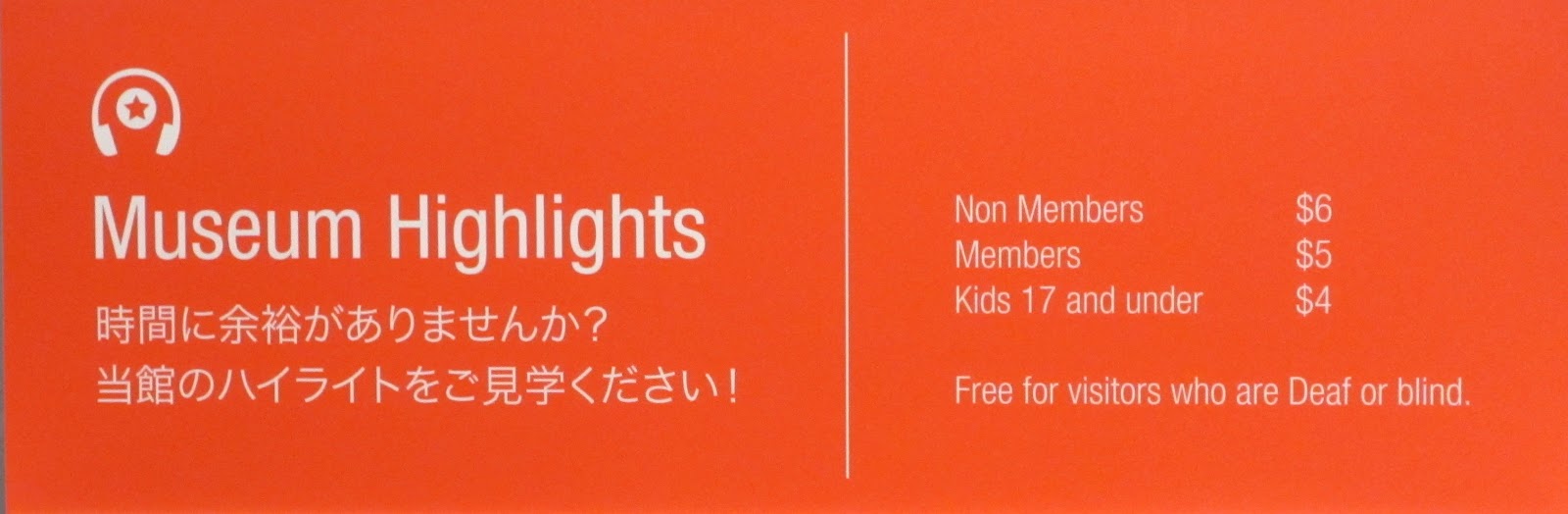
Sign behind the ticket counter

Last night was week four of the protest against Kimono Wednesdays organized by a group of Asian Americans and week two of counterprotesting organized by Japanese teacher Timothy Nagaoka who has lived in the US for almost two decades. I should note that I don't agree with the protesters (please read my original and follow-up posts for my detailed thoughts on this) and I support Timothy (who I met last night but have corresponded with before) so I'm not an unbiased observer.

Protesters against Kimono Wednesdays
I counted 18 protesters, though there may have been more. This is up from the “about a dozen” that the Boston Globe reported were there last week. I was late and the gallery was crowded, so people may have come and gone before I arrived or without my noticing. I have tried not to speculate about the heritage of the protesters but people have asked me who was there so I'll say that my sense was that they were 2/3 Asian American (including hapa folks and one protester who has identified herself as Japanese in signage but identified herself as Japanese American on Facebook) and 1/3 white allies. I do not believe that any Japanese nationals have joined their protest at the MFA but I have seen a few supportive comments on Facebook from people identifying themselves as Japanese.

Counterprotesters who would like the original event to return
I saw seven counterprotesters but there were actually nine. Timothy, five older Japanese women, one younger Japanese woman, and two younger white Americans (an age range from 20s to seniors). Seven of them were wearing kimono or yukata. (Full disclosure: three of the protesters are my friends.) The young folks told me they had been invited by one of my friends and didn't think they would have gone to counterprotest had they not been invited by someone Japanese. As white people they said they try to be mindful of their privilege. Timothy said he had five signs from last week and made five new signs for this week so everyone had one. One of the new signs quoted from Avenue Q's "Everyone's A Little Bit Racist": "Everyone's a little bit racist sometimes. Doesn't mean we go around committing hate crimes. Look around and you will find no one's really color blind. Maybe it's a fact we all should face, everyone makes judgments based on race." See photos here. See last week's post for other signs.


Always the educator:
"I am a Japanese language teacher, and I welcome museum exhibits that share Japanese culture with the community."
"Monet's painting represents the fascination that the French had for Japan in the nineteenth century, and the "Kimono" represents the fascination that the Japanese have for the painting today. "Kimono Wednesday" joins the fascination between the two countries."


Signs that addressed the protest and the MFA's decision to curtail the try on portion of Kimono Wednesdays read:
"'La Japonaise' celebrates the West's fascination with Japan. Let us take part in the celebration by putting on the kimono."
"Wearing a kimono does not make me a Racist or an imperialist." (pictured in the Boston Globe)
"The protesters have a right to be offended, but it should not dictate the enjoyment of others.
"I am Japanese, and I am offended that non-Japanese people have hijacked a Japanese exhibit that was started in Japan and well received there." (As noted above they have some Japanese American support but none of the organizers is Japanese American.)

The woman in the black floral yukata had made her own sign with quotes from Youtubers Rachel & Jun's Can Foreigners wear Kimono? response to the Kimono Wednesdays protest. "Rachel: Let me ask you some questions about when it's okay for foreigners to wear kimono. Jun: when it's okay for foreigners to wear kimono? Okay, there is only one answer, whenever."

Counterprotesters in kimono and yukata

All of Timothy's signs included a plea to the MFA to "Bring Back Kimono Wednesday," although at this point I don't think any of the counterprotesters believe the MFA will reinstate that part of the event this month. I think they all felt that it was important to be there to express to the MFA and the public that they don't see anything wrong with the event in its original form. There's also a lot of frustration among Japanese people that the protesters have hijacked a Japanese cultural event to their own ends (per Timothy's sign above - though I don't know if if all the counterprotesters share that view). The fact that NHK gave the uchikake as a gift to the MFA and they (the uchikake) are being treated in this manner seems quite embarrassing to some. Japanese and other Asian media outlets have not done a good job of framing the protests leading many Japanese people to conclude that the protest is anti-Japanese. Some feel that the charges leveled against the MFA are by extension leveled against all of Japan because this was a gift from Japan and the event originated there. The protesters have not made any anti-Japanese statements and have said the charges are only against the MFA, however they have continued to be dismissive of dissenting Japanese and Japanese American opinions saying that Japanese opinions are irrelevant because they don't live here (responding to opinion from Japan, not from Japanese nationals living here) and that Japanese and other Asian Americans who live here don't have the capacity to understand their protest and are defending the white power structure.

I saw a comment from a white supporter of the protesters that the counterprotest only responds to the kimono-wearing aspect thereby missing the point the protesters are trying to make, but I see it as Japanese people and non-Japanese kimono lovers wanting to make it clear that they do not believe it's racist to try on or wear a kimono and that they don't agree with the protesters linking their issues around racism and sexism to Kimono Wednesdays. That isn't missing the point of the protest it's saying they don't agree with the false equivalence between Kimono Wednesdays and racism, imperialism, white supremacy, rape of QTWOC (queer trans women of color), and the deaths of people of color at the hands of white Americans. It doesn't address what any of the counterprotesters think about those issues separate from Kimono Wednesdays.

I think to some degree the protest and counterprotest highlight cultural differences between Japanese nationals living in both Japan and the US and Asian Americans (including some Japanese Americans), although all the Japanese women who joined Timothy's counterprotest are also long-time residents of the US so I'm sure that as Asian women living in this country they've faced some of the same racist, sexist, culturally ignorant, and just plain awkward behavior that all Asian and Asian American women I know have had to deal with. I don't think they are unfamiliar with some of the issues the protesters have raised. Japanese people living in Japan are also not unaware of the fact that life in America can be dangerous for foreigners. The October 1992 murder of 16-year-old Yoshihiro Hattori, an exchange student from Nagoya who was staying in Baton Rouge, Louisiana, was a huge deal in Japan and the fact that it was followed by three more murders of Japanese students in less than a year an a half made headlines in Japan. Less than a year after Hattori's murder, 25-year-old exchange student, Masakazu Kuriyama, died after being shot in Concord, California in August 1993. Police suggested it might have been an attempted robbery but said they were not ruling out a hate crime. Seven months later two Marymount College students, 19-year-olds Takuma Ito (Japanese national) and Go Matsuura (US national who grew up in Japan), died following an attempted carjacking in San Pedro, California. However, the Japanese seem to see these murders as a symptom of America's lax gun control rather than a problem related to racism. Hattori's shooter was white, Ito and Matsuura's carjacker was mixed race ("white, Mexican, and black descent"), and Kuriyama's assailant was never found. (I should note that these murders happened so long ago that young Japanese people may not be aware of them.)

I saw two protesters holding the same sign that I absolutely don't agree with: "Japanese Americans don't have the option to experience white culture just for fun." It was unclear to me if they both identify as Japanese American. If they do, I'm not sure how they go about experiencing "white culture" but I enjoy "white culture" "just for fun" all the time. (There is no such thing as "white culture" but for the sake of this argument I'll define it as anything related to "American culture" or the culture of an ancestral home of white people who live in America.) Some examples: I go out to dinner at white-owned restaurants and enjoy “white” cuisine with white friends. I attend musical concerts put on by white musicians who play music written and composed by white people. I once attended a pirate-themed party (throw by some white friends, of course) dressed as a wench. I also attended the coronation of a friend in the SCA ("an international organization dedicated to researching and re-creating the arts and skills of pre-17th-century Europe") when she was crowned Queen of the East Kingdom. Under her tutelage I made Viking garb for myself and a male friend who didn't have the sewing skills to make his own garb. None of the many white people in attendance accosted me and demanded to know why I as an Asian American was wearing the garb of their ancestors. I have some Italian Americans in my extended family. No one asks me if I understand the cultural significance of meatballs and pasta before they allow me to dig in. I don't understand how any Asian American can not experience "white culture" "just for fun". How else would you experience it?

Someone else had a sign that read
"La Japonaise: 
21st CENTURY
AMERICAN IMPERIALISM
~@ it's finest~
Pay $ to the MFA to
devalue the experiences of
people of color & exercise your
PRIVILEGE!"
I imagine this is referring to the MFA's exhorbitant $24 admission fee but as I keep pointing out, admission on Wednesdays during the time that Kimono Wednesdays are scheduled for is "by voluntary contribution" so the MFA is not making money off of Kimono Wednesdays and this is how the protesters have been able to go every week. Some people feel that Kimono Wednesdays were meant to be a viral marketing stunt because people would post their photos to social media but even if that's the case I still don't have a problem with it. Maintaining an art museum like this is not cheap and unlike the Smithsonian and art museums in other countries the MFA is not funded by taxpayer dollars. If people don't show up, they can't exist.

I wasn't sure what to expect from the protesters this week after reports I'd read and a video "conversation" they posted with Timothy last week on their now deleted Facebook page (which I wrote about last week). I did hear some heated conversations but for the most part I would say that the protest and counterprotest were peaceful. MFA staff told me at the end of the evening that the protesters behaved better this week than they had last week, although the counterprotesters who had attended the first Kimono Wednesday and spoken to protesters that night said they have become much more aggressive. It was my impression that contrary to what the protesters have said about it being their rule not to approach people they did approach the counterprotesters and initiate discussion. One of them told me she's never been treated more rudely in her entire life by most of the protesters she talked to. Only one conversed with her respectfully. Given the sort of rhetoric I've seen on their Facebook page I'm not surprised. I have not heard if they treated the older Japanese women with more respect than they afforded the white counterprotesters.

I asked MFA staff a question that has been asked by many Japanese people – why are the protesters permitted to be in the gallery? They said that ordinarily large protests are not permitted in the building or even on MFA grounds. They must stay on the sidewalk off MFA property. However in this case, the protest started really small (3 people the first week according to the staff) and they didn't feel protesters were being disruptive. As a museum they want people to talk about the art and since the protest sparked dialogue they decided to let them stay. It has been suggested that you should call the police or 911 if you get into a confrontation with protesters in the next two weeks. It is illegal to waste police time on things that are not a crime, accident, or medical emergency. It is not illegal to protest or to argue with people. Update 7/26/15: I found out last week that the MFA didn't have a policy to handle a situation like this since it had never happened before. I forgot to ask if they're working on a policy in case something like this this happens in the future.

Kimono Wednesdays are scheduled to continue through the end of July on Wednesdays with Spotlight Talks at 6:00pm - 6:15pm, 6:45pm - 7:00pm, and 7:15pm - 7:30pm. Admission on Wednesdays after 4pm is "by voluntary contribution" so it can be free if you want it to be. Please note that the protesters have stated in the past that they intend to be there every Wednesday. There are no plans for counterprotests for the remainder of the month but perhaps some individuals will show up to counterprotest.

Note: I have chosen not to show the faces of the protesters. I know they're posting their own photos on social media but I'm also aware that they are being harassed so I didn't feel it would be right to show their faces. I'm also not using their group's name because I find it offensive.


See also

Related posts

Updates
  • 7/17/15 4:10pm: Fixed some spelling and punctuation errors. Added some sentences with more detail on Japanese reaction to the protests.
  • 7/18/15 5:00pm: Updated the number of counterprotesters. This post originally said there were seven counterprotesters, six in kimono and yukata. 
  • 7/18/15 8:00pm: Added second photo of counterprotesters courtesy of Timothy Nagaoka. 
  • 7/19/15: 3:25am: Added link to The Boston Globe counterprotest article. 
  • 7/19/15: 3:10pm: Added age range because some people seem to think the counterprotesters were all older.
  • 7/22/15 12:55pm: Updated link to protest Tumblr. Protesters have removed their original Tumblr (see here at archive.org) and rebranded as "Decolonize Our Museums."   
  • 7/26/15 2:55pm: Added/clarified information from MFA staff about the size of the protest and why they were permitted to stay.
  • 2/10/16: It has come to my attention that one of the white counterprotesters identifies as genderqueer. This post has been updated to correct the misgendering. I apologize for the error!

Part 1: La Japonaise replica uchikake @ Kimono Wednesdays

Adult size La Japonaise replica uchikake

Please see my original post for background on the history of Camille Monet's uchikake and the MFA's Kimono Wednesdays: Monet's La Japonaise Kimono Wednesdays at the MFA.


Wendy Dodek talks about La Japonaise
I finally made it to Kimono Wednesday at the MFA last night. Wendy Dodek, Gallery Learning Lead Educator, who gives many Spotlight Talks for the MFA has been giving the Kimono Wednesday talks. The MFA suggests that they allow visitors to "Dig deeper into a work of art with knowledgeable MFA staff," however talks are too short to allow visitors to dig too deeply – "Take fifteen minutes to look more closely and discover stories, techniques, and histories of fascinating objects in the Museum." The MFA is gigantic so I understand that the average visitor isn't going to want to attend a lengthy talk or workshop. Spotlight Talks offer something in between just looking at the art and attending a long event.

Taira no Koremochi
I have seen criticism of past Kimono Wednesday Spotlight Talks but from what I could hear it seemed educational and covered a brief history of the painting and the character depicted on Camille's uchikake, Taira no Koremochi from the shosagoto (a kabuki dance-drama) Momijigari. More was probably covered but I found it hard to hear because the Sidney and Esther Rabb Gallery is large and has very high ceilings so the room swallows sound. I was also moving around a lot taking photos and talking to people. Timothy Nagaoka, who also counterprotested last week, told me that this week's talk was more informative than last week's. After the talk Ms. Dodek took questions. I asked who had made the replica uchikake. She didn't have the information in her notes but emailed it to me later. The two uchikake (one adult size and one child size) were produced by the Takarazuka Stage Co., a stage management company that owns the famous Takarazuka Revue, an all female revue founded in 1913. The uchikake replicas were funded by NHK to accompany the MFA's traveling exhibit, Looking East: Western Artists and the Allure of Japan, during its Japanese tour and then generously donated by NHK so that the MFA could host similar events to those that happened in Japan. I was told by another MFA staffer that after Kimono Wednesdays end the uchikake will remain in MFA storage as items associated with La Japonaise and may be used for future events.

Anyone who is a fiber artist, especially those who sew, weave, and embroider should check out the uchikake before it goes into storage. I might have to go back to take another look. The gallery was quite crowded and there was a lot going on with the protest and counterprotest so I didn't realize until I got home that I'd mostly been looking and thinking about the uchikake in terms of what pictures I needed for the blog, not from a fiber arts perspective. About the only thing I managed to note on that front was the variety of Japanese embroidery techniques used and the quality of the work.

Child size La Japonaise replica uchikake
I spoke with two counterprotesters who had been fortunate to attend the first Kimono Wednesday and try on the uchikake. The taller woman had tried the adult size and the shorter woman tried the child size. They both said that you think it's heavy but then you try it on and it's even heavier than you'd imagine. When I was checking out the adult size replica uchikake with my friends, one of them told me that she rented an uchikake when she got married but the one she wore did not weigh as much because there was much less embroidery on it. Japanese women rent uchikake for weddings because unless you're ridiculously wealthy you can't afford to buy one.

Kimono Wednesdays are scheduled to continue through the end of July on Wednesdays with Spotlight Talks at 6:00pm - 6:15pm, 6:45pm - 7:00pm, and 7:15pm - 7:30pm. Admission on Wednesdays after 4pm is "by voluntary contribution" so it can be free if you want it to be. Please note that the protesters have stated in the past that they intend to be there every Wednesday. There are no plans for counterprotests for the remainder of the month.


Additional photos here. They include more close-ups.

See also: Part 2: Protest and counterprotest @ July 15th Kimono Wednesday

Further reading

Related posts

Tuesday, July 14, 2015

Kickstarter: Bring Real Kimono to New York Fashion Week


New York and Florida-based kimono fashion stylist, Hiromi Asai, has teamed up with Kimono Artisan Kyoto, an association of Japanese textile artisans, to bring kimono to New York Fashion Week in 2016. They launched a Kickstarter campaign in June and are a little more than halfway to their $50,000 goal with 17 days to go. They will not receive any money unless they reach their goal. They have incredibly beautiful rewards for those who can afford it ($50 - $10,000).

Kimono is a dying art that won't survive if kimono artisans are not able to generate more interest outside of Japan. You can see from the chart on their Kickstarter page just how dramatically the industry has shrunk in the past 30 years. Japan-based retailer Uniqlo recently launched a Women's Yukata Collection ($69.90) as well as one for girls ($59.90) in their US stores which might help pique interest in kimono but these are mass-produced garments and won't help the skilled artisans who produce high-quality kimono.

Further reading

Monday, July 13, 2015

Japanese American and Japanese reaction to Kimono Wednesdays

Please see my original post for background: Monet's La Japonaise Kimono Wednesdays at the MFA.

 
I would like to preface this post by saying that I don't condone the public or private harassment of the protesters in the form of slurs, insults in Japanese, assumptions about their heritage, and death threats (they have written on Facebook and Twitter about receiving such harassment). I don't agree with much of what they've said, I don't approve of their tactics, and they have been very rude on their Facebook page but they are human beings and treating them this way does not help the situation and is more likely to make things worse.

There are a lot of conspiracy theories floating around that because they are non-Japanese Asian Americans they must be working for foreign governments. My favorite one was that they are agitprop workers working for the DPRK (North Korean government). This is complete nonsense and a common charge (that we are agents/spies of a foreign government) when people feel that the motives of Asian Americans are suspect. I haven't met any of them but my impression is that they are regular Asian Americans struggling with issues of race in a country that is frequently hostile for non-whites. They have been completely dismissive of Japanese Americans, Japanese, and white residents of Japan who have tried to talk about Kimono Wednesdays in the context of Japanese cultural sharing and a dying kimono culture and industry because they feel this is about America not Japan, but I see that as being related to American arrogance not anti-Japanese views. Though I have no idea if they personally hold anti-Japanese views because of their family histories.

I would also like to point out that some of the reaction to the protesters that I've read around the Internet is based on things they have not said. When this first started to go viral the protesters didn't have much in the way of substance on their now deleted Facebook page so many people were making assumptions about what they were trying to say on the basis of their signs and what people imagined they did at the MFA. They have since posted a LIST OF DEMANDS AND CHARGES" (preserved here by archive.org in case they delete it again - please read for yourself and decide what you think) and have two new Facebook pages (organization page here and event page here). There's been a lot of misinformation on social media and the media has done a poor job of reporting (especially in Japan from what I've heard) so some of the responses have been to things other people have attributed their beliefs and motives to be, not things they've actually stated.


I've been talking to a lot of people for the past week and a half and heard and read lots of great commentary on Kimono Wednesdays. I wanted to share some of them because I still feel like non-Japanese Asian Americans and whites are dominating the conversation. These comments are all supportive, but I have heard from some Japanese Americans who feel the MFA's actions were inappropriate and at a minimum culturally appropriative.

After I heard about the protests at the MFA, one of my first emails was to my dear friend, Izumi Noguchi, a kimono enthusiast who runs the Boston Kimono Club (sorry, no website) and is very knowledgeable about kimono. She said that her mission is for kimono to be appreciated by everyone regardless of race. Izumi has organized kimono try on events at several matsuri around the area and she also lectures on kimono and has been invited to speak at several universities.

I got her permission to share the response she sent back last week. We talked about the protests a little more this past weekend and she told me she was actually very happy to hear that the MFA had organized Kimono Wednesdays. At work, she's often in charge of organizing Asian cultural events to raise awareness and give people a better understanding of Asian cultures. Izumi loves that non-Japanese staff take an interest and help organize these events. She doesn't feel that the only people allowed to speak and share about Japanese culture are Japanese and Japanese Americans. (Note: I haven't been able to get anyone at the MFA to talk to me so I don't know the racial make up of the staff who worked on Kimono Wednesdays but most people seem to be working on the assumption they must all be white.)

First of all, I was shocked to read many angry responses from people (most of them seem Asian decent and one Japanese person) saying the MFA is a racists. I know it would have been better if there was a lecture on kimono to understand all about kimono but it seems this is just a fun event to try on kimono/uchikake. It seems this Uchikake was made in prestigious Kyoto and it's so rare to see it and let alone to put it on! Why not "white people" or any people try on kimono?

It's one of my lifetime works to spread the word that kimono is for everyone. You don't have to be Japanese or Asian. You can wear it when you have a blond hair or your skin is dark. It doesn't matter who you are. I believe they all look great in kimono. Whenever I did "kimono try-on" at the festivals or workshops, they love it and they smile. Am I a racist? Absolutely not! Last year, so many non-Asian people purchased kimono and haori at the summer festival. They ask me where they can purchase. That makes me so happy.

A few days ago someone posted on the protest Facebook page a draft of a letter to the MFA in support of Kimono Wednesdays from a sansei West Coast Japanese American, Barbara Hayashida. I reached out to Barbara and she told me that she heard about the controversy through a Facebook group called "You know you're Japanese-American when..." She expressed disagreement with the protesters that the event was promoting orientalism and someone said if she wrote a letter, they would sign. She posted the draft and within 24 hours had 68 signatures in addition to her own (we are not sharing the names of the other signatories to respect their privacy). I think if she had collected signatures through the weekend she would have gotten many more. Most of the signatories don't know each other and they're not trying to start a counterprotest group, they just wanted to express their concerns to the MFA and let Japanese American and Japanese voices be heard (most signatories were Japanese American). Barbara shared the final draft of their letter with me.


Today someone posted a Facebook group to the protest page called the Japanese-Global Alliance to Support Kimono Wednesday at Boston MFA. The group's description: "This is a community to let people know that most Japanese don`t even think the "Kimono Wednesday" is racist and we want MFA to start the event again." Some of the information being posted to the group is not accurate (ie: you should not call 911 to report the protesters unless they have become violent or are destroying property - though really I'd leave that up to the MFA security to handle) but it's a place to find like-minded people who support Kimono Wednesdays.

I'm told there are two other Facebook groups that support Kimono Wednesdays but neither group is public so I haven't been able to look at their pages and won't be sharing the links.

I hope that Japanese Americans and Japanese people will continue to make their voices heard on social media and to the MFA. If you would like to contact the MFA you can use the webform on their contact page.

Thank you to Izumi and Barbara for sharing their thoughts!

Update 7/17/15: I found another Japanese American writing about the protests! I've been corresponding with sansei author, Jan Morrill, who signed Barbara Hayashida's letter. You can read her thoughts at her blog: Outrage Over a Red Kimono? Update 7/24/15: Jan has written a follow-up post: Mind Your Own Business.

Update 7/19/15: More Japanese and Japanese American reaction in Sunday edition of The Boston Globe: Counter-protesters join kimono fray at MFA including quotes from my friend, Etsuko Yashiro, who counterprotested, Dr. Paul Watanabe, director of the Institute for Asian American Studies at UMass Boston, and Dr. Ken Oye, who teaches political science and engineering at MIT and is co-president of the New England Japanese American Citizens League. Finally, a journalist who is asking the opinions of prominent Japanese and Japanese Americans!

Also, for more Japanese perspective on kimono see The Japan Times: Underneath the ‘Orientalist’ kimono.

Update 7/21/15: Japanese artist and arts activist, Kentaro Ikegami, sent a letter to the MFA in his role as the Arts Advocacy Program Manager for the National Coalition Against Censorship. He was critical of the self-censorship and referred the MFA to NCAC's Museum Best Practices for Managing Controversy.

Update 8/2/15: Dr. Kei Hiruta, Research Fellow and Global Outreach Coordinator at the Oxford Uehiro Centre for Practical Ethics, published "Stop Orientalism?: On Boston MFA’s ‘Kimono Wednesdays’" in the University of Oxford's Practical Ethics blog arguing that although the event may have been orientalist, that doesn't necessarily make it wrong.
"It is a curious fact about our contemporary culture that, in places like Boston at least, the wrongness of Orientalism is considered so self-evident that those commenting on ‘Kimono Wednesdays’ have largely focused on whether the event is Orientalist, sidestepping harder questions as to specifically what is wrong if the event is Orientalist and (assuming, for the moment, that it is indeed Orientalist) whether the wrongness of Orientalism should override other considerations. But the latter set of questions demand greater attention not least because, as I have argued, the pervasiveness of Orientalism today might not be separable from the moral progress we have made in the past couple of centuries. Addressing the relevant moral and historical issues fully is a challenging task; for starters, we should recognise the triviality of the oft-made assertions about the MFA event: ‘This is Orientalist!’ ‘No, it is NOT Orientalist!’"

 Related posts


Updates
  • 7/22/15 12:50pm: Updated link to "LIST OF DEMANDS AND CHARGES". Protesters have removed their original Tumblr and rebranded as "Decolonize Our Museums."
  • 7/26/15 3:15pm: Updated "preserved here" link to point to archive.org.

Counterprotest this Wednesday @ the MFA

Timothy Nagaoka stages a one-man counterprotest at the MFA on July 8th

Please see my original post for background: Monet's La Japonaise Kimono Wednesdays at the MFA.
Write-up about the second counterprotest: Part 2: Protest and counterprotest @ July 15th Kimono Wednesday.

Timothy Nagaoka, who counterprotested at the MFA last Wednesday, asked me to share this message inviting anyone of any race who would like to see the MFA reinstate the try on portion of Kimono Wednesdays to join him this week. If you have a kimono or yukata please feel free to wear it.

Kimono Wednesdays are scheduled to continue through the rest of the month on Wednesdays with Spotlight Talks at 6:00pm - 6:15pm, 6:45pm - 7:00pm, and 7:15pm - 7:30pm. The protesters have stated in the past that they intend to be there every Wednesday.


Date & Time
Wednesday, July 15, 2015
6:00 - 8:00pm

Location
Museum of Fine Arts
Sidney and Esther Rabb Gallery (Gallery 255)
465 Huntington Avenue, Boston, MA 02115

Admission
Admission on Wednesdays after 4pm is "by voluntary contribution" so it can be free if you want it to be. Admission is usually $24 for adults.

Invitation from Timothy Nagaoka
My name is Timothy Nagaoka, and last Wednesday, July 8th, I went to the Museum of Fine Arts (MFA) in Boston to protest their decision to limit the visitor's interaction with the "Kimono" drawn in Claude Monet's painting, "La Japonaise."

Before the opposition for the exhibit, the museum allowed visitors to try on the replica of the "Kimono" worn by Monet's wife in the painting. The "Kimono" was commissioned by the Japanese national broadcaster, NHK when the painting toured the country last year, and it was very well received in Japan as part of the exhibit.

However misguided and unfounded the protesters' opposition to the "Kimono" and their claims of "Racism" and "Imperialism" are, with the museum yielding to their demand, the media has portrayed their opposition as the sentiment of the Boston community. I believe that their negative sentiment towards the exhibit is in the minority, and that the majority of people--both, Japanese and Non-Japanese--in the Boston area are in favor of the exhibit and would like to have the opportunity to put on the "Kimono."

I will be protesting one last time at the MFA this Wednesday, July 15th from 6:00pm to 8:00pm. With the waning media interest in the topic, I feel that this may be the last chance to make an appeal to the museum to bring back "Kimono Wednesday."

Actions speak louder than words so if you agree with me please join me in the protest on Wednesday and please share this message with your friends and colleagues.
  
Related posts

Sunday, July 12, 2015

2015 New England Summer Festivals

We have three upcoming matsuris in the New England area.

Next weekend is the 32nd Annual Black Ships Festival in Newport, Rhode Island. It runs Friday, July 17th - Sunday, July 19th. Check their website for details. The festival commemorates the history of kurofune, Western ships that opened up trade with Japan. Rhode Island might seem like an odd location for such a festival but Newport is the birthplace of Commodore Matthew Perry who negotiated the Kanagawa Treaty, the first treaty between the US and Japan.

Update 7/19/15: I just found out there are two natsu matsuri on Saturday July 25th. Circle of Boston Nursery School in Watertown, Massachusetts will have a Summer Festival from 10am - 1pm. Given that it's a nursery I'm sure it will be very child-friendly.


On Saturday, July 25th and Sunday, July 26th from noon - 3pm you can go to Medford for the Ebisuya Summer Festival at the only remaining exclusively Japanese grocery store in the Boston area. According to the flyer "If you come wearing a Yukata, Kimono, or other traditional Japanese clothing you will be given a free Green tea Shake!" Based on what I've seen at past Ebisuya festivals they will not be offended if non-Japanese people wear traditional Japanese dress. I doubt the MFA protesters will show up.


Next month on Sunday, August 26, 2015, Hana Japan Restaurant in Newburyport, Massachusetts will host their fifth annual Natsu Matsuri (summer festival). Unfortunately, details aren't up on their website or Facebook yet. The Natsu Matsui is small and family-friendly and includes games, dancing, usually taiko, and wonderful food. Photos from last year's matsuri. I will update this post when I have the hours. Based on previous years I'd guess it will be in the early afternoon.

Saturday, July 11, 2015

Japanese people talk about whether it's okay for foreigners to wear kimono

Found some videos on YouTube last night that I had to share. I don't know if all Japanese people would agree but it seems like Japanese people may not have a sense of cultural appropriation as a thing.

American Rachel and her Japanese husband Jun discuss when, where, and how it's appropriate for foreigners to wear kimono. Conclusion: anytime, anywhere, and even "incorrectly" is okay. Jun pointed out that many Japanese people don't know much about kimono history or even how to put them on and go to photo studios to be professionally dressed and photographed. Check out their blog here. Video is in English.


Zach didn't get all the facts straight but he got some interesting comments from Japanese friends at Sophia University in Tokyo where he goes to school. Kyosuke pointed out that in Japan people don't wear kimono regularly so when they do, they take a picture, so he thinks it's understandable that foreigners would want to do the same and he thinks that's fine.

Sachiko brought up Katy Perry's AMA performance and said she didn't think it was racist. I hadn't given any thought to what Japanese people would think of her performance before I wrote my critique, but after I'd finished, I emailed a Japanese friend and asked her. She was not at all offended by the performance.

Video is mostly in English with English subtitles when Japanese is spoken.


Related posts